TR
TR
 21 September 2026
Water, the most fundamental requirement for a healthy body, does more than simply quench thirst; it also plays a key role in countless vital functions, ranging from cellular activity to the regulation of body temperature. When it comes to appropriate fluid intake, referring to a standard ‘two litres a day’ rule that applies to everyone is, from a medical perspective, an incomplete approach. An individual’s body weight is the most decisive factor here. For this very reason, you should base your water intakeon a weight-based chartto determine the ideal amount of water suited to your own physiology. The body of a healthy adult consists of an average of 60 to 70 per cent water, and even a loss of just 2 per cent of body weight in water can negatively affect brain function, leading to problems with concentration.
When determining our daily water intake, we should take into account not only our weight but also environmental conditions and our dietary habits. People do not meet their entire fluid requirements for cellular activity simply by drinking water from a glass. Foods consumed throughout the day that have a high water content – such as cucumber, watermelon, strawberries, courgette, soup and ayran – are sources of ‘virtual hydration’, or hidden water intake, which account for approximately 20 to 25 per cent of our total daily water requirement. Despite this reality of ‘invisible water’, it is essential to monitor net fluid intake regularly to ensure the body is cleansed of waste products and kidney function is maintained. The Centres for Disease Control and Prevention (CDC), which provide global guidance on this subject, state that individuals turning to clean water sources appropriate to their body weight helps prevent chronic fatigue.
Key Biological Factors Affecting Daily Water Requirements
Whilst fluid intake guidelines generally address the question ‘why is water important?’, the biological basis for this need is often only touched upon superficially. In fact, the process of calculating a person’s daily water requirement is shaped by factors directly linked to body mass, such as body surface area, organ size and metabolic rate. The larger your body surface area, the more water you lose through sweating and breathing. Similarly, age also has a significant impact on hydration. As we age, the body’s ability to retain water decreases, and the hypothalamus – the centre that regulates the sensation of thirst – may lose its former sensitivity. This means that older people must consciously ensure they drink water, even if they do not feel thirsty.
The Effect of Muscle and Fat Proportions on Hydration by Gender
In human anatomy, sex is one of the most critical structural differences determining water requirements. Men’s higher muscle mass compared to women’s directly affects their fluid requirements. Whilst muscle tissue contains approximately 70 per cent water by weight, this proportion drops to around 10 per cent in adipose tissue. This biological reality demonstrates that a man and a woman of the same weight may not require the same amount of water.
Men, who have greater muscle mass, require 10 to 20 per cent more water than women for cellular repair and the management of intramuscular glycogen stores. On the other hand, whilst the higher natural body fat percentage in women’s body composition reduces their basal fluid requirement to some extent, extra water is required to flush out oedema during hormonal cycles (the menstrual period). Therefore, understanding gender-specific physiological characteristics is the first step towards developing a personalised hydration strategy.
How Is Daily Water Intake Calculated Based on Body Weight? (Scientific Formulas)
Rather than providing readers with standard, set-and-forget figures in litres, leading authorities in medicine and nutrition recommend simple formulas to enable them to make their own calculations. The most widely accepted and reliable formula is the rule that a person should consume between 33 and 35 millilitres (ml) of water for every kilogram of body weight. This figure represents the minimum requirement for individuals leading a sedentary lifestyle and living in a temperate climate. However, there is a very important technical detail (the EEAT rule) to bear in mind here.
Individuals on the verge of obesity (with a Body Mass Index above 30) may place an excessive strain on their kidneys if they apply this formula directly to their current weight. Excessive water consumption can lead to a dangerous drop in blood sodium levels, resulting in a life-threatening condition known in medical terms as hyponatraemia (water intoxication). To eliminate this risk, it is a clinical necessity for overweight individuals not to use their current weight directly, but to calculate the average of their ‘ideal weight’ and ‘current weight’ and apply the 33 ml formula to this average value.
Sample Calculations Based on Individuals Weighing 70 kg and 80 kg
Seeing the formula for calculating daily personal water requirements in practice will make the subject much clearer. For example, let’s take a healthy adult weighing 70 kilograms who is at their ideal weight. When we multiply this person’s body mass by the lower limit of 33 ml (70 x 33 ml = 2,310 ml), the result is approximately 2.3 litres. If the same person is actively involved in sport, they should consume approximately 2.45 litres, using the upper limit of 35 ml.
Similarly, when we calculate this for a person weighing 80 kilograms (80 × 33 ml = 2,640 ml), we see that the minimum daily requirement is approximately 2.6 litres. As can be seen, even a weight difference of just 10 kilograms results in a difference of 300 millilitres (approximately one and a half glasses of water) in the ideal daily water intake.
The interactive chart below illustrates the amount of fluid that individuals of ideal weight should consume each day.
Table of Daily Water Requirements by Body Weight (Litres)
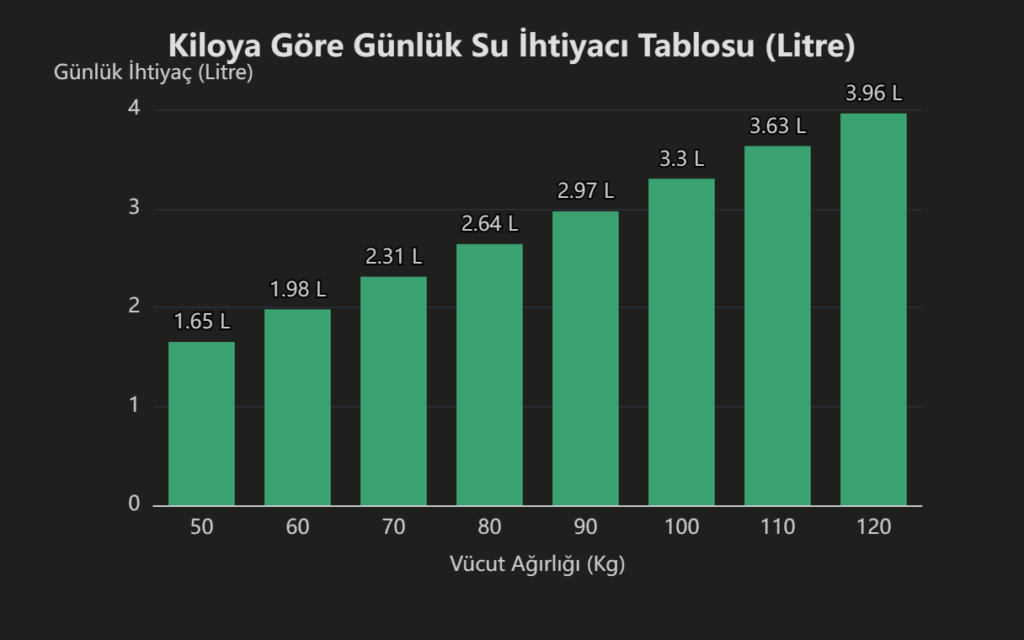
(Note: The table above shows the basal requirements calculated by multiplying your weight by 33 ml. The ratios may vary in specific cases.)
Detailed Water Intake Chart by Weight (For Women, Men and Children)
Rather than reducing the amount of water required to a single formula, categorising it according to age groups and specific circumstances is essential for maintaining proper fluid balance. It is generally recommended that adult men consume between 2.5 and 3.5 litres of fluid per day, whilst women should consume between 2 and 2.7 litres. However, these figures can vary significantly depending on specific physiological stages a person is going through (illness, growth spurts, reproductive periods).
One of the most important strategies for water intake is to drink 1–2 glasses of water at room temperature as soon as you wake up in the morning. This action, which instantly replenishes the fluids lost through breathing and sweating overnight, stimulates the digestive system and helps kick-start your metabolism. You can gamify this routine using tech apps such as Waterful or Hydro Remind, thereby solving the problem of forgetfulness.
Increased Fluid Requirements During Pregnancy and Breastfeeding
Pregnancy and lactation (breastfeeding)—which are among the most special periods in a woman’s life—require extra care when it comes to hydration levels. During pregnancy, the body’s blood volume increases significantly; in order to replenish the amniotic fluid surrounding the baby and ensure the healthy progression of foetal development, it is essential for the mother to consume at least 300 ml to 700 ml of extra water in addition to her baseline requirements.
During the breastfeeding period, however, this need reaches its peak. Approximately 87 per cent of breast milk consists of water. For this reason, it is essential for a breastfeeding mother to add between 700 ml and 1 litre of water to the amount corresponding to her weight in the daily water requirement calculation table, in order to maintain uninterrupted milk production and prevent dehydration in her own body. Otherwise, the mother may experience severe headaches, fatigue and a reduction in milk supply.
Ideal Measurements for Infants and Young Children
The fluid requirements of children and babies follow a very different pattern compared to adults. During the first six months, babies obtain all the fluid they need from breast milk (or formula), so there is no need to give them any extra water. From the sixth month onwards, when they start eating solid foods, they should be given water in small sips.
In pre-school and school-age children who are still growing, however, their rapid growth and high levels of physical activity increase the risk of fluid loss. A daily fluid intake of 1–1.3 litres is recommended for children aged 1 to 3 years, and 1.3–1.7 litres for those aged 4 to 8 years. As children’s thirst mechanisms are not as well developed as those of adults, it is of critical importance for parents to regularly encourage their children to drink water at the playground or at school, to support kidney health and cellular development.
Conditions That Directly Increase Water Requirements Apart From Weight
Although the basic formula is based on body weight, living conditions and environmental factors have a modifying effect on the ideal amount of water. Increased sweating during hot summer months, a more rapid breathing rate at high altitudes, or suffering from a feverish illness immediately increases the body’s rate of fluid loss. Particularly in cases of infection, such as diarrhoea and vomiting, where fluids are lost very rapidly along with electrolytes, it is necessary to replenish fluids at a rate significantly higher than the litres indicated in the standard guidelines.
Intense Training, Thermogenic Effect and Pre-Exercise Hydration
For those who exercise regularly, fluid intake is a far more critical issue than for sedentary individuals, both in terms of performance and recovery. The body attempts to reduce the increased heat generated during training by sweating. For every half kilogram of weight lost (through sweat) during this process, the athlete must drink at least an additional 500 ml of water.
Scientific research has shown that drinking water has a direct effect on calorie expenditure. According to this mechanism, known in the literature as the ‘thermogenic effect’, your body expends extra energy (calories) to bring the cold or cool water you drink up to your body temperature of 36.5 degrees. According to DoctorCalendar Nutrition Research, drinking 500 ml of water in one go can increase the resting metabolic rate by between 24 per cent and 30 per cent for 30 to 40 minutes. For this reason, ensuring the correct level of hydration before and after workouts significantly boosts the fat-burning process.
Symptoms of ‘Hidden Dehydration’ and Common Misconceptions
Although we may think we are constantly drinking fluids throughout the day, our bodies may actually be becoming dehydrated from the inside out. The symptoms of mild to moderate dehydration are often mistaken for hunger; as a result, when people are dehydrated, they may reach for snacks rather than drinking water. Unexplained headaches, difficulty concentrating, mild dizziness when standing up suddenly, and persistent dry mouth are the most fundamental signs of hidden dehydration. Recognising these symptoms correctly helps prevent the premature ageing of organs.
Do Tea and Coffee Meet Your Daily Water Intake Requirements?
One of the most widespread misconceptions in society—and one that is, unfortunately, widely believed to be true—is the notion that tea, coffee or fizzy drinks can be used as a substitute for water. Coffee and strong tea have a medically recognised ‘diuretic’ (urine-inducing) effect due to their high caffeine content. In other words, rather than providing the body with fluid intake, these drinks stimulate the kidneys, thereby accelerating the excretion of fluid from the body.
Tea and coffee, which office workers in particular never let go of at their desks, cannot provide the cleansing and moisturising effect that pure water offers to cells. On the contrary, for every cup of coffee consumed, an extra glass of pure water must be drunk to compensate for the dehydration it causes in the body. Pure water is an indispensable component that can easily pass through the cell membrane and cleanses the metabolism.
Individual Hydration Test Using Urine Colour and Skin Elasticity
You don’t need expensive tests to work out whether you’re meeting your body’s daily fluid requirements. A urine colour chart and skin elasticity checks, which you can carry out yourself, provide accurate data on your hydration levels. The colour of your urine reflects how concentrated your kidneys are working. A light, almost clear or pale yellow colour indicates an excellent fluid balance, whilst a dark yellow or amber colour is a warning sign that you need to drink water immediately.
Another effective physical test is the skin turgor test. Gently pinch the skin on the back of your hand or the lower part of your arm between two fingers, pull it upwards, and then release it. If your skin immediately (within fractions of a second) returns to its original flat shape, this indicates that you are well hydrated. However, if the skin takes longer to return to its original state and loses its shape, this means your cells are experiencing significant fluid loss.
The Easiest Way to Access Healthy and Safe Water: Water Treatment Solutions
Water accounts for approximately 34 per cent of all packaged drinks consumed worldwide. Access to this most precious liquid, on which humanity relies for survival, is not always safe, given today’s environmental pollution and infrastructure problems. The risk of plastic exposure from bottled water and the problems of heavy metals, chlorine and limescale in tap water have prompted conscious consumers to seek out different alternatives. When consuming the 2.5 or 3 litres of water per day calculated according to your formula, this water must have a high pH value, be rich in minerals and be microbiologically flawless. This is precisely where modern technology comes into play.
Uninterrupted and Mineral-Rich Hydration with Domestic Water Purification Systems
The most sustainable, reliable and economical way to access high-quality water at home is to invest in advanced filtration technologies. Ensuring the pH level of the water you consume is alkaline aids digestion whilst boosting the rate of cell regeneration. Rainwater domestic water purification systemsare an excellent solution for increasing your family’s daily water intake and ensuring you have access to delicious water at all times. Thanks to reverse osmosis and mineral-enriching filters, you can get water straight from your tap that is free from heavy metals, soft to drink and enriched with essential minerals such as calcium and magnesium. Having clean water readily available in the kitchen will enhance your hydration levels not only as drinking water but also when preparing meals and brewing tea or coffee.
Water Dispensers with Filtration Systems for Offices and Workplaces
In the offices where we spend a large part of our working lives, forgetting to drink water or running out of bottled water leads to dehydration, which directly reduces staff focus and productivity. Ensuring that staff working in enclosed spaces and under a hectic workload have uninterrupted and convenient access to healthy fluids is an integral part of corporate wellbeing. Filtered water dispensersystems, which eliminate the hassle of changing water bottles, the problem of plastic waste and the hygiene risks arising from storage conditions, are a perfect innovation for offices. These water dispensers, which are integrated into the mains water supply, instantly filter out all harmful particles from the water, providing your staff with the convenience of hot and cold filtered water 24/7.
Frequently Asked Questions
How do we know if we’re drinking enough water?
One of the most reliable ways to tell if your body is sufficiently hydrated is to check the colour of your urine; a pale, light yellow or almost clear colour indicates a good level of hydration, whilst a dark yellow or amber colour is a warning sign that you are dehydrated. In addition, the elasticity of your skin (the skin on your hand springing back immediately when you gently pinch and release it), the absence of dryness in your mouth and on your lips, a regular bowel movement routine, and not feeling unexplained tiredness during the day are the most obvious signs that you are drinking enough water.
How many kilograms is 1 litre of water on a set of scales?
The specific gravity (density) of water is approximately 1 g/cm³ at standard room temperature and at sea level. Due to this physical principle, the volume and mass of water are equal. In short, exactly 1 litre of pure water, measured on a precision balance, is equivalent to exactly 1 kilogram (1000 grams). The equivalence of mass and volume provides great convenience in formula calculations.
Does drinking plenty of water help burn fat?
Drinking water does not directly melt fat cells, but it strongly supports the process of weight loss and fat burning. According to a phenomenon known in the literature as the ‘thermogenic effect’, particularly when you drink water that is cold or at room temperature, your body expends extra energy (calories) to bring this water up to a body temperature of 36.5 degrees. Adequate water intake also increases the basal metabolic rate. Indeed, according to data published in Vogue, individuals who drank 500 ml of water 30 minutes before each main meal were found to have lost 44 per cent more weight after 12 weeks compared to those who did not drink water.
How much water should someone weighing 70 kg drink?
According to generally accepted medical guidelines, a healthy adult should drink an average of 33 to 35 ml of water for every kilogram of body weight. Based on this guideline, a person weighing 70 kilograms has a daily water requirement of approximately 2.31 litres. If a person is exercising, recovering from a feverish illness or living in a hot climate, this amount should be increased to replace fluids lost through sweating. In cases of obesity, the ideal weight should be used as the basis rather than the current weight.
 Copy Blog Link