TR
TR
 7 October 2026
Inside water softeners, a chemical process takes place that is invisible to the naked eye but fundamentally alters the hardness of the water: ion exchange. This process is based on a proven and straightforward principle that has been used in industry and domestic water treatment for over a century. In this article, we explain in simple terms what ion exchange is, its role in water softening, and how it differs from other treatment technologies.
| Important Notes: Ionexchange is based on the principle whereby the calcium and magnesium ions responsible for water hardness are replaced by sodium ions on the resin; this is the fundamental operating mechanism of water softeners.Ion exchange removes hardness but does not significantly reduce TDS (total dissolved solids) — in this respect, it differs from reverse osmosis (RO). The resin becomes saturated over time and requires regular regeneration with salt (NaCl). |
What is Ion Exchange?
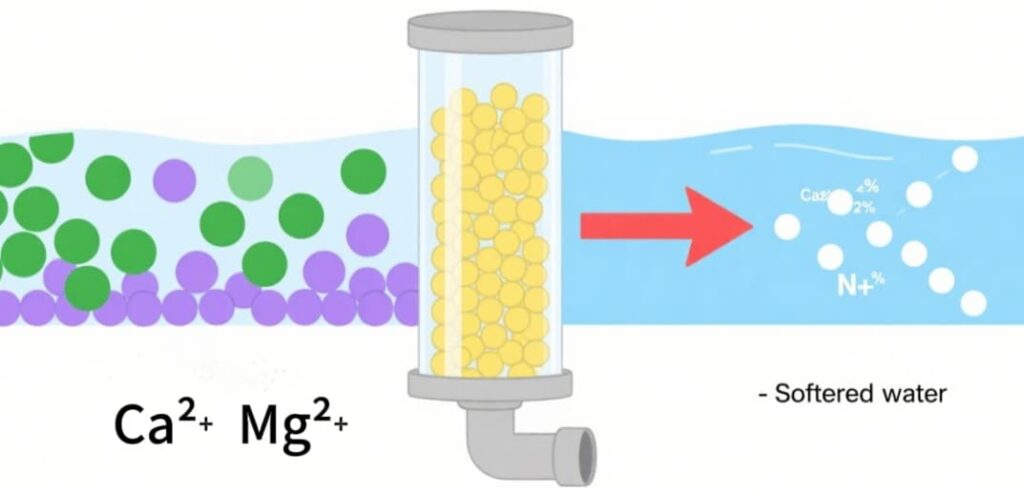
Ion exchange is a chemical process based on the principle that certain ions in a solution are exchanged for other ions on a material such as resin. In the context of water treatment, its most common application is the replacement of calcium and magnesium ions—which cause water hardness—with sodium ions on the resin. This process is not filtration but an exchange process; the unwanted ions in the water are not physically filtered out, but are chemically exchanged.
How Does Ion Exchange Work in Water Softening?
The water passes through a tank containing resin beads charged with sodium ions. Whilst the calcium and magnesium ions in the water are retained by the resin, the sodium ions on the resin are released into the water. In this way, the minerals that cause water hardness are removed, and sodium ions—which do not cause hardness—are added in their place. This exchange takes place within a few seconds as the water passes through the resin tank and operates continuously and without interruption.
What is the difference between ion exchange and reverse osmosis?
Ion exchange selectively removes the ions responsible for hardness; it does not significantly alter the water’s TDS value, as sodium ions are added to the water in place of calcium and magnesium. Reverse osmosis , on the other hand, uses a semi-permeable membrane to generally reduce the majority of dissolved solids in the water, including minerals. Consequently, the two technologies serve different purposes: whilst one focuses on removing hardness, the other provides a more general and comprehensive form of purification. In practice, these two technologies are not mutually exclusive; in many comprehensive water treatment systems, the water is first softened and then passed through a reverse osmosis stage.
When Should an Ion Exchange Resin Be Regenerated?
As the resin absorbs calcium and magnesium ions from the water, its capacity gradually becomes saturated and its water-softening efficiency decreases. At this point, the resin must be rinsed with a concentrated salt solution (NaCl solution) to release the ions it has retained and be recharged with sodium ions; this process is called regeneration. The frequency of regeneration varies depending on water hardness and daily water consumption; in modern systems, this cycle is usually managed by an automatic timer or water meter. For further information on the physical lifespan and maintenance of the resin water softening resin .
What are the advantages and limitations of ion exchange?
The most significant advantage of ion exchange is its ability to soften even very hard water quickly and continuously; the process operates continuously and requires no additional energy source. As the system has a relatively simple mechanical design, maintenance costs are also comparatively low. Among its limitations are the addition of a small amount of sodium to the water (which is why people on very low-sodium diets are advised to exercise caution), the production of saline waste water during regeneration, and the fact that the process focuses solely on hardness and does not provide protection against other bacterial or chemical contaminants. For this reason, if comprehensive water quality is the objective, ion exchange is generally not planned as a stand-alone process but in conjunction with other treatment stages.
Is Ion Exchange Used Only for Water Softening?
No, ion exchange has a wide range of applications beyond water softening. Ion exchange resins are used in the production of pure water in laboratory settings, for the removal of specific ions from water in the pharmaceutical and food industries, in the preparation of boiler feedwater at power stations, and even in certain analytical chemistry applications. Although water softening is the most common application in domestic water treatment, the principle itself has been reliably applied across a much broader range of engineering fields for decades.
In Which Water Sources Does Ion Exchange Become More Important?
The benefits of ion exchange increase in direct proportion to the natural hardness level of the water. In regions with a geological structure rich in limestone, mains water or well water may contain high levels of calcium and magnesium; in such regions, ion-exchange-based water softening makes a more noticeable difference both in protecting domestic plumbing from limescale build-up and in enhancing the comfort of daily life. In water sources with lower hardness, however, the benefits of the same system may be noticeably more limited; therefore, knowing the water hardness level in the region before investing in the system helps to set realistic expectations.
Frequently Asked Questions
What are resin-based water softening systems?
These are systems that operate on the principle of ion exchange and are usually regenerated regularly using brine. They consist of a resin tank, a salt tank and a control valve that manages the regeneration cycle.
How is water softened?
The most common method is to use ion-exchange water softeners. These devices reduce the water’s hardness level by replacing the minerals that cause hardness with sodium ions.
Does ion exchange add flavour to water?
In a properly functioning system, no noticeable difference in taste is detected; however, when the resin’s capacity is exhausted or regeneration is carried out irregularly, a slight salty taste may be detected in the water, in which case the resin must be checked.
If you would like to examine the practical implications of the ion-exchange principle in more detail—namely, the resin’s service life and maintenance— our article on water softening resin , and for a range of units, the ‘water softening units’ category .
 Copy Blog Link