TR
TR
 21 September 2026
The growing global demand for clean water and dwindling freshwater resources have made the use of advanced filtration technologies essential in water purification processes, ranging from industrial facilities to modern homes. Undoubtedly, the biggest problem reducing the efficiency of equipment in the process of purifying water at a molecular level is limescale and the build-up of inorganic deposits. The question of what an antiscalant is– the most powerful and definitive solution developed in chemical engineering literature to combat this chronic problem – is of great importance to plant managers seeking to maximise system lifespan and reduce treatment costs. To summarise briefly: antiscalants are high-performance water treatment chemicals that prevent dissolved inorganic minerals in water from crystallising, particularly on reverse osmosis(RO) membrane surfaces, thereby preventing the formation of microscopic blockages (scale). In these systems, where water is forced to pass through pores measuring one millionth of a millimetre in diameter under incredibly high hydrostatic pressure, the combination of cations such as calcium and magnesium to form a layer as hard as concrete can cause the system to fail within a short period. It is precisely at this stage that specially formulated active ingredients come into play; by intercalating between water molecules, they halt the crystallisation reaction before it even begins physically and ensure that the minerals are flushed out through the waste water line.
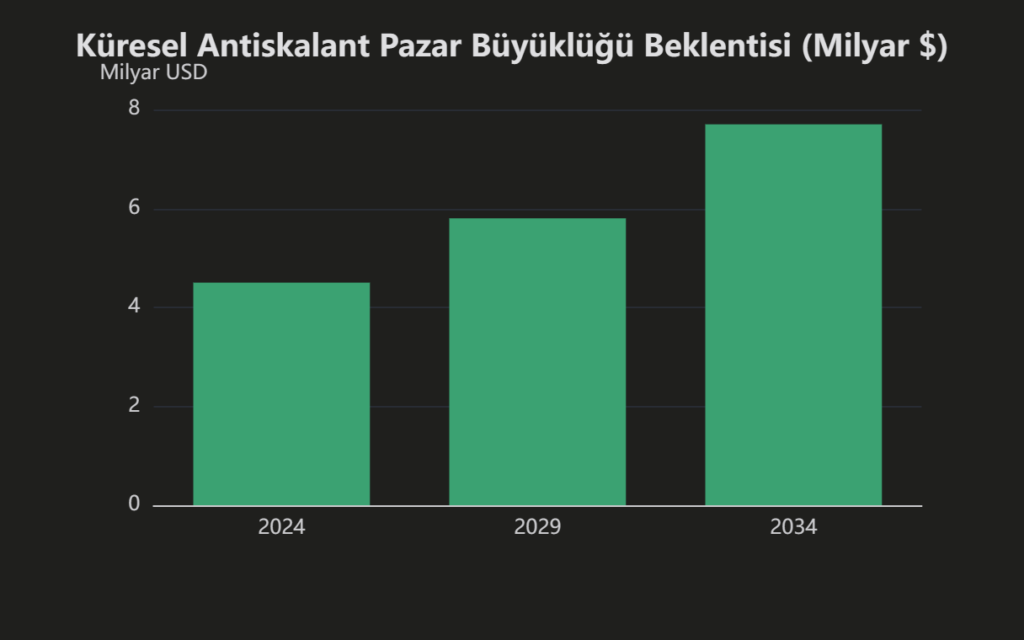
Sector-specific research and economic data analyses indicate that the global water treatment chemicals market is gaining tremendous momentum with each passing day and that, by 2033–2034, the market size is set to reach a range of 59 to 74 billion US dollars. The specific sub-market for scale prevention chemicals, which lies at the heart of this tremendous growth, is forecast to reach a volume of between 7.5 and 8.0 billion US dollars by 2034. Alongside advancing technology, this scale prevention engineering underpins not only the operations of vast factories processing tonnes of water but also the advanced, compact appliances used in our homes. To illustrate how the sector has evolved into an area of technological and economic investment over the years, you can examine the growth forecasts in detail in the chart below.
Global Antiscalant Market Size Forecast (billion $)
What is the purpose of an antiscalant in water treatment, and why is it a critical chemical?
Mechanism for Preventing Membrane Fouling (Scale)
Semi-permeable polyamide membranes, which form the heart and most valuable component of reverse osmosis units, separate water at a molecular level to produce pure water. However, due to the geological structure of the source, ions such as silica, calcium, magnesium, barium and strontium—tend to precipitate (supersaturation) as they become concentrated on the surface of the membrane’s retentate (waste water). Specially synthesised anti-scaling chemical solutions interfere with the natural crystal lattice structures of these inorganic salts in the water, disrupting their growth geometry at the microscopic level. Known in engineering as “crystal distortion” and ‘threshold inhibition’ in engineering, this dual-action chemical defence mechanism prevents particles—which would otherwise bind together to form a hard, glass-like and stubborn layer of scale—from forming physical bonds. Consequently, these dense minerals – which under normal conditions would clog the membrane – flow away via the wastewater discharge line without causing any damage to the filter surface.
Energy Efficiency and Its Direct Impact on Equipment Lifespan
Over time, as an invisible layer of limescale and sediment begins to form on the membrane surface, a much greater driving force must be applied to the system to allow water to pass through these clogged pores. This logarithmic increase in the value known in the literature as Transmembrane Pressure (TMP) causes the high-pressure pump in the treatment system to exert considerably more effort and, naturally, leads to a dramatic increase in the plant’s electricity consumption (kWh/m³). A membrane that is kept clean, however, ensures that the system operates with the same hydraulic dynamics as on the first day, at optimum energy levels and at the planned flow rate. Furthermore, the frequency of the highly costly acid-based ‘Cleaning in Place’ (CIP) procedures required to clean membranes clogged with limescale is significantly reduced. As aggressive CIP chemicals such as hydrochloric acid or sodium hydroxide degrade the polymer structure of the membrane over time, water treatment methods that prevent limescale formation from the outset extend the membrane’s service life to at least 3–4 years, thereby significantly reducing depreciation costs.
Antiscalant Composition and Basic Chemical Structure
The Role of Polyacrylic Acids and Phosphonates
The formulations of commercial scale inhibitors available on the market for industrial use consist of synthetic polymer chains specifically developed in the laboratory to match the target ion profile of mains or well water. Among these components, whose molecular weights generally range from 2,000 to 10,000 daltons, polyacrylic acid derivatives (based on the C3H4O2 monomer structure) and phosphonates (R-PO₃H₂), are the most common active ingredients in the water treatment sector. Phosphonate-based antiscalants, in particular, currently dominate approximately 39.4 per cent of the total market, as they provide exceptional resistance to calcium carbonate (CaCO₃) and calcium sulphate (CaSO₄) scaling. By forming complex bonds with calcium ions in the medium, phosphonate molecules have the capacity to break the crystallisation chain in vast volumes of water, even at doses far lower than those calculated stoichiometrically. This unique chemical stability enables uninterrupted treatment performance even at high temperatures or in groundwater where hardness levels are extremely high.
Environmentally Friendly (Green) Antiscalant Technologies
Worldwide, the water treatment industry has undergone a revolutionary green transition in recent years, in line with sustainability targets and the vision of carbon neutrality. Whilst traditional phosphorus-based polymers can lead to eutrophication (algal blooms) when they enter the sea or lakes via discharged wastewater, new-generation, environmentally friendly (green) antiscalant technologies stand out for their high biodegradability. Synthesised using natural enzymes or plant-derived carbon backbones, these environmentally friendly formulations break down naturally within a short period in the environment, delivering industrial-standard treatment efficiency without harming aquatic life or agricultural soils. The tightening of wastewater discharge standards by international regulatory authorities – such as both European Union directives and the US Environmental Protection Agency ( EPA) – is driving plant managers to rapidly transition from synthetic phosphonates to environmentally friendly green polymers.
Industrial and Domestic Applications
Industrial RO, Desalination and Cooling Towers
The freshwater shortage caused by global warming has made seawater desalination one of the most important infrastructure investments for governments. Indeed, statistics show that the Middle East and North Africa (MENA) region alone accounts for nearly 48 per cent of the current global seawater desalination capacity. The process of converting seawater—which has a total dissolved solids (TDS – Total Dissolved Solids) and mineral content reaching levels of 40,000 ppm, is physically impossible without tonnes of precisely calculated antiscalant chemicals. Similarly, continuous chemical dosing is carried out in the closed-loop circulation systems of massive cooling towers at petrochemical plants or thermal power stations to prevent heat transfer surfaces from becoming encrusted with limescale. Even a millimetre-sized limescale blockage in these critical heat exchangers – the very heart of heavy industry – would obstruct heat transfer, leading to emergency shutdowns (downtime) that could result in millions of dollars’ worth of production losses.
Its Role in Commercial and Domestic Water Treatment Systems
In addition to the enormous volumes of water handled in heavy industry facilities, high-capacity water treatment systemsused in office blocks, hospitals, laboratories or café and restaurant businesses also essentially utilise the same RO engineering principles. In these commercial systems, protecting the internal membranes against seasonal fluctuations in the quality of mains water—such as chlorine levels, turbidity and hardness—is essential to ensure that the molecular purity and taste of the produced water remain consistent. Professionally designed modern purification systems regulate water flow dynamics using a hydrodynamic design philosophy that minimises limescale build-up both physically and structurally. Meeting the drinking water needs of businesses employing hundreds of staff continuously and at the same laboratory-grade quality 24 hours a day is only possible if these scientific filtration defence mechanisms, operating behind the scenes of the system, function correctly and without wear and tear.
Engineering Criteria to Be Considered in the Selection and Dosage of Antiscalants
Water Analysis and LSI (Langelier Saturation Index) Assessment
The selection of a water softener to be integrated into the system must never be carried out at random, by guesswork or by trial and error. The first step in a proper water treatment project is to carry out a detailed physicochemical laboratory analysis of the raw water entering the plant and to precisely determine the water’s pH, temperature, calcium hardness and total alkalinity parameters. The LSI (Langelier Saturation Index), calculated on the basis of this scientific data, uses mathematical formulas to indicate the water’s tendency to form scale (precipitation) or to be corrosive. As a positive (+) LSI value indicates a high potential for calcium carbonate scaling in the water, a phosphonate derivative in the correct proportion should be selected to break the specific crystal bonds involved. In waters with high salinity, such as seawater, the formula is selected by referring to the S&DSI (Stiff & Davis Saturation Index) value rather than the LSI; as incorrect use of chemicals may not only fail to provide any benefit but could also trigger the formation of an irreversible gel/sludge layer (fouling) on the membrane.
Artificial Intelligence (AI)-Enabled Smart Dosing Systems
With the Industry 4.0 transformation, modern water treatment plants today manage chemical dosing processes not using manual valves or analogue pumps with fixed flow rates, but through smart algorithms capable of making autonomous decisions based on instantaneous changes in water quality, occurring within milliseconds. Depending on the conductivity, flow rate and instantaneous temperature of the influent water, the ideal antiscalant dosing rates typically fall within an extremely precise range of 2 to 10 ppm (parts per million). Artificial intelligence (AI)-based digital twins, which process continuous data from IoT (Internet of Things) sensors integrated into the pipework, for example, by calculating the changing scaling kinetics when the water cools during the winter months, intervene in real time to adjust the dosing pump and autonomously optimise the volume of liquid to be injected. This technological revolution not only prevents unnecessary chemical wastage (overdosing) but also ensures a zero-risk operation by preventing the plant from being exposed to scaling due to underdosing. To reduce the margin of error in the system’s data calibration to zero, periodic water quality reports provided by independent laboratories accredited by TÜRKAK, the statutory accreditation body, must always be accepted as the primary reference.
What are the differences between these and other water treatment chemicals?
Polymeric chemicals used in industrial wastewater treatment and freshwater production processes are often confused with one another by on-site staff; however, the function and reaction mechanism of each molecule are entirely different. When designing a water treatment roadmap for a plant, it is essential that engineers accurately identify the specific type of dissolved or suspended contaminant to be addressed. The table below clearly summarises the differences between the three most commonly used components in water treatment.
| Chemical Type | Basic Function and Operating Principle | Target Pollution / Waste Type |
| Antiscalant | By disrupting the molecular crystallisation process of dissolved ions, it prevents them from adhering to and calcifying on membrane surfaces. | Calcium, Magnesium, Silica, Sulphate (Dissolved inorganic salts) |
| Coagulant | It neutralises the electrical repulsive force between small, negatively charged particles, destabilising them and causing them to coalesce. | Silt, clay, organic colloids (suspended and colloidal solid particles) |
| Dispersant | It ensures that solid microparticles that have settled or are beginning to agglomerate remain evenly dispersed and suspended in the liquid. | Iron oxides, biological sludge, flocculated inorganic suspended solids |
Hazards of Antiscalants and Conditions for Safe Use as Set Out in the MSDS
Although scale-inhibiting polymers are extremely reliable components when added to water in very low concentrations—at a level of one part per million (ppm)—within a water treatment system, they may be classified as industrial hazards in their pure (concentrated) form during shipment. For this reason, strict compliance with international Material Safety Data Sheet (MSDS) procedures is a mandatory legal requirement in factories. In their concentrated form, these liquids generally have an acidic pH value (between pH 2.0 and 4.0), depending on their active ingredients; direct contact with the skin, mucous membranes or eyes can cause severe irritation and corrosive burns. Storage areas must be cool, dry, shielded from direct sunlight and well-ventilated using industrial fans. Furthermore, the floor must be fitted with epoxy-coated spill containment basins to prevent potential drum punctures and chemical leaks. In the event of any accident, it is an absolute priority for personnel responding to the incident to use personal protective equipment (PPE) such as acid-resistant nitrile gloves, chemical-splash goggles and a full-face shield; this is one of the non-negotiable rules regarding health and safety at work.
The table below lists the international safety warning symbols commonly found on the packaging of such concentrated industrial chemicals, and the precautions that should be taken.
| MSDS Safety Symbol | Hazard Class and Potential Effects | Staff Protection Methods and Equipment |
| Corrosive (Corrosive Symbol) | It causes corrosion on metal surfaces; it can chemically corrode skin and eye tissue, causing permanent damage. | Durable nitrile gloves with long cuffs and side panels, fully enclosed face shield, PVC apron. |
| Exclamation Mark | If inhaled or if it comes into contact with the respiratory tract or skin, it causes allergic reactions or severe redness. | Half-face respirator with activated carbon filter, safety goggles, emergency eye wash. |
| Harmful to the Environment (Trees/Fish) | If released into the environment uncontrolled, it has severe toxic effects on aquatic life, groundwater and agricultural land. | Use of absorbent sausage-shaped barriers at the time of a spill; storage in a sump. |
Of course, these industrial hazards apply only to large manufacturing plants housing tanks holding several tonnes. In theself-contained, stylishly designed enclosed water purification dispensersused in modern offices, hospitals or homes, consumers have absolutely no physical contact whatsoever with these processes or chemicals; the entire limescale prevention and purification cycle is managed entirely automatically within isolated technological compartments within the unit’s internal architecture, using materials that are 100 per cent compatible with human health.
Frequently Asked Questions (FAQ)
What is a dispersant, and how does it differ from an antiscalant?
A dispersant is a specialised chemical substance that prevents solid particles in water or other liquids from sticking together, clustering and agglomerating by interfering with their electrical charges. High-quality commercial antiscalants, thanks to the dispersant properties incorporated into their formulations, not only prevent the crystallisation of dissolved ions; but also prevent microscopic crystals or surrounding sludge that have already formed on the membrane surface from combining to form massive limescale deposits, thereby ensuring that this contamination remains suspended in the liquid. The fundamental difference in engineering terms is this: whilst antiscalants focus on preventing inorganic ‘precipitation and calcification’ at the molecular level, dispersants aim to break up the ‘agglomeration’ of physical particles at the macro scale.
Will a reverse osmosis (RO) system work without an antiscalant?
Although the system will continue to produce physical water in the short term and at low capacities, depending on the level of inorganic hardness in the raw water entering the plant, the polyamide membrane pores will become completely blocked with limescale and silica deposits (usually within a few days or weeks). If no chemical conditioning measures are taken, the transmembrane pressure (TMP) rises rapidly and uncontrollably due to the resistance of the membrane, causing the flow rate and purity of the treated water produced by the system to drop dramatically. Ultimately, the system’s equipment – particularly the high-pressure pumps and valves – will overheat due to excessive mechanical stress, fail within a short time, and production will cease permanently.
Is reverse osmosis healthy?
Reverse osmosis is the world’s most advanced and reliable purification technology, which completely removes heavy metals (lead, mercury, etc.), viruses, bacteria, microplastics, pesticide residues and harmful dissolved chemicals from water. After purifying raw water of contaminants at a molecular level and bringing it to a pure state, vital minerals essential for human health—such as calcium, magnesium and potassium—are restored to the water in the correct proportions via natural ‘alkaline and mineral filters’ integrated into the final stage of the purification system. Thanks to this scientific process, the result is healthy drinking water that is 100 per cent microbiologically safe, has a high pH level that supports cellular hydration, and boasts an excellent flavour profile.
What is a reverse osmosis system?
It is an advanced filtration system in which water is forced, against the natural osmotic pressure balance in nature, through a specialised semi-permeable (semi-permeable) special membrane with microscopic pores (approximately 0.0001 microns in diameter). This technology traps dissolved salts, heavy metals, limescale and other molecular contaminants from mains or well water on one side of the membrane, directing them directly to the waste water (concentrate) line, whilst allowing only pure H₂O molecules (permeate) to pass through the other side of the membrane. First invented to produce drinking water in spacecraft and naval submarines, this system is now an indispensable cornerstone of industry and modern homes. We can build a bluer world. Share the unique insights from this in-depth guide right now on your social media accounts, with your friends and colleagues; to create that much-needed, widespread awareness in the name of corporate sustainability and the salvation of our planet – don’t wait for tomorrow; take action today, right now!
 Copy Blog Link