TR
TR
 21 September 2026
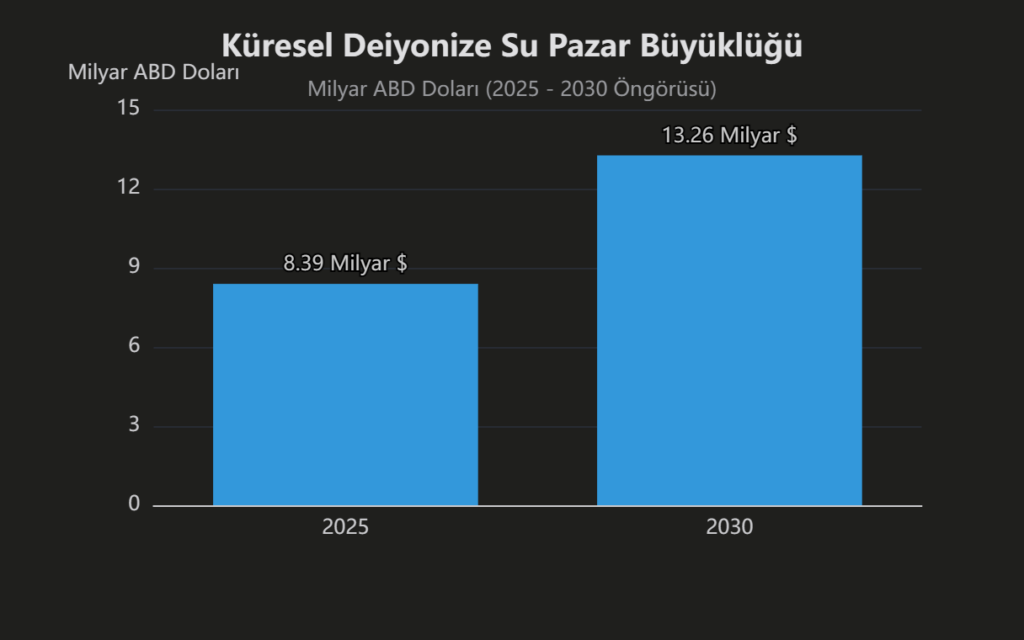
From industrial production facilities to high-tech research laboratories, there is a fundamental question that arises in many sensitive working environments: What is deionised water, and how does it differ technologically from standard tap water? In its simplest terms, deionised water (DI water) is neutral water that has been completely purified of the mineral ions (calcium, sodium, iron, chloride, etc.) it contains, which carry an electric charge. Produced using the ion-exchange method, this liquid loses almost all of its electrical conductivity, becoming an excellent insulator and a pure solvent. Today, the importance of this water in industry is so great that the global deionised water systems market is expected to grow from 8.39 billion dollars in 2025 to 13.26 billion dollars by 2030.
According to industry standards, the terms ‘pure water’and ‘ultrapure water’(UPW) are generally classified according to the water’s electrical resistivity. Deionised ultrapure water sits at the top of the hierarchy of purified waters, which are graded as Type I, Type II and Type III, particularly according to standards set by the American Society for Testing and Materials (ASTM). With a resistivity of 18.2 MΩ.cm at 25°C, this liquid acts as a ‘blank canvas’ for chemical reactions, ensuring it does not alter the chemistry or quality of the products produced in any way.
The graph below illustrates the forecast for steady growth in the Global Deionised Water Systems Market between 2025 and 2030, in line with the rise in industrialisation and high-tech production. This immense volume demonstrates just how vital water quality is as an investment asset for modern industry.
Global Deionised Water Market Size
How Does the Deionisation Process Take Place in the System?
Adjusting water to aneutral pH level of7.0 and reducing its ionic conductivity to zero is a highly complex chemical engineering process. In nature, as water is an excellent solvent, it absorbs various minerals as it passes through rocks, soil and pipes. When these minerals dissolve in water, they turn into ions with either a positive or negative electrical charge. The deionisation process is designed to remove these electrically charged impurities from the water, leaving behind only hydrogen and oxygen molecules (H₂O).
The Operating Principle of Ion-Exchange Resins
At the heart of deionisation lie synthetic resinbeds, which resemble small, porous plastic beads. The system essentially uses two types of resin: cation (which attracts positive ions) and anion (which attracts negative ions) resins. As water passes through these beds, positively charged ions in the water—such as calcium, magnesium or sodium—are trapped by the cation resin, and hydrogen (H+) ions are released in their place. Similarly, negatively charged ions such as chloride or sulphate are captured by the anion resin, and hydroxide (OH⁻) ions are released into the water in return. These released H⁺ and OH⁻ ions immediately combine to form new, completely pure water molecules.
This ion-exchange resintechnology, which has become the industry standard, is so efficient that it is constantly being developed to meet the specific needs of different sectors. Indeed, an analysis of large-scale systems installed today reveals that Mixed-Bed Deionisation (MBD) technology, which delivers high-quality results, holds a dominant market share of around 80 per cent. Mixed-bed systems represent the highest level of purification, whereby cation and anion resins are homogeneously mixed within the same tank, thereby ensuring that the water is deionised thousands of times before it leaves the tank.
The Key Differences Between Deionised Water and Distilled Water
The terms ‘DI water’ and ‘distilled water’are the concepts most frequently confused in liquid purification technologies. Although both are used to obtain high-purity water, the engineering principles behind them and the characteristic properties of the final product are entirely different. In the design of a laboratory or industrial facility, the choice between these two methods is determined by the degree of precision required for the intended application.
A Comparison of Physical Evaporation and Chemical Purification
Distilled water is produced by replicating the natural rain cycle in a laboratory setting, that is, through a physical phase change. The water is heated to its boiling point and evaporated, leaving behind minerals and heavy metals in the boiling vessel; the vapour is then condensed using a cooling coil and transferred to another vessel. This method eliminates all organic contaminants, bacteria and viruses in the water, providing a completely sterile liquid; however, there is a risk that some volatile organic compounds (VOCs) or minerals may be carried over, albeit in very small quantities, during the evaporation process. Deionised water, on the other hand, undergoes a chemical and electrical filtration process without requiring any heating (and therefore without high energy consumption). It is flawless in terms of ionic purity and has a conductivity close to zero; however, it does not guarantee biological sterility unless an additional ultraviolet (UV) filter is fitted to the system.
| Comparison Criterion | Deionised Water (DI Water) | Distilled Water |
| Production Method | Ion-exchange synthetic resins (chemical/electrical) | Boiling and steam condensation (Physical) |
| Purity Level (Ions) | Ion purity of nearly 100 per cent (perfect conductivity zeroing) | Highly purified, but may contain trace amounts of ions |
| Risk of Pathogens (Bacteria) | If a pre-UV/RO unit is not added to the system, it will not kill bacteria | The boiling process removes bacteria and viruses (it is sterile) |
| Ideal Applications | Industrial production, Cosmetics, Semiconductors, Car batteries | Medical applications, Safe laboratory procedures, Human consumption/CPAP devices |
In which industries and sectors is deionised water used?
The potential for industrial use of deionised water is virtually limitless. The absence of impurities in a solvent makes it the easiest raw material to work with in product development and production processes. It serves as a ‘blank canvas’ across a wide range of applications, from chemical analyses to boiler feedwater in power stations.
The Need for Ultra-Pure Water in Semiconductor (Microchip) Manufacturing
The production of microchips, which form the heart of the modern electronic world, requires incredibly precise conditions. When examining a modern chip manufacturing plant today, we find that semiconductor and chip facilities alone account for 35 per cent of the global demand for deionised water, and that a modern plant consumes between 2 and 4 million gallons of water per day. During the washing process for chips manufactured using 3-nanometre and smaller architectures, even a single microscopic calcium or sodium ion in the water can cause permanent short circuits between transistors. In these facilities, which represent investments worth billions of dollars, the zero conductivity provided by deionised water is a vital safeguard.
Particularly in regions where technology giants such as Taiwan, South Korea and Japan are concentrated, the Asia-Pacific region is seen to hold a leading position in the global ultra-pure water market, with a share of approximately 41 per cent, as a direct reflection of the chip industry. The exponential growth in production volumes in the region year on year is increasing the reliance on neutral solvents used in chip washing, wafer cutting and acid etching processes.
The economic impact of this massive demand is quite striking; official reports indicate that, driven by technological advancements, the ultra-pure water market is projected to reach a volume of 10.2 billion USD by 2025 and is forecast to reach 18.3 billion USD by 2034. As the production of hardware for Industry 4.0 and artificial intelligence processors accelerates, the fundamental driving force behind this multi-billion-dollar market will continue to be the need for impeccable water quality.
The Use of ‘Aqua’ in Cosmetic Formulations (INCI)
When you look at the list of ingredients (INCI) on a luxury moisturiser or an expensive shampoo you’ve picked up off the shelf, you’ll usually see the term ‘Aqua’ at the top of the list. In cosmetic chemistry, this ingredient is nothing more than deionised waterin itspure form. A shampoo produced using tap water disrupts the saponification process because the ions it contains – such as calcium and iron – react with the active organic ingredients. The formula’s viscosity is compromised, its colour becomes dull, its scent changes and its shelf life is drastically reduced. Deionised water is the most critical emulsion stabiliser, ensuring that lotions retain their smooth texture.
Specialist Marine Aquariums and Hobby Systems
For hobbyists setting up a reef or marine aquarium at home, tap water is a nightmare. Ions such as silicate, nitrate and phosphate found in tap water are not only toxic to sensitive coral species, but also the primary food source for the brown diatom algae that coat aquarium glass within days. To prevent this unwanted ecological outbreak, aquarists always add a DI (Deionisation) resin filter to the final stage of a standard reverse osmosis (RO)system. This RO/DI unit reduces the Total Dissolved Solids (TDS) level in the water to exactly zero (0 ppm), ensuring that artificial salt mixtures designed to mimic the ocean environment dissolve perfectly.
Health Effects: Is it safe to drink deionised water?
Beyond the technical jargon, one of the issues end-users are most curious about is whether this high-tech product is suitable for human consumption. The short answer is: although deionised water is not technically toxic or directly lethal, experts strongly advise against drinking it. Throughout human evolution, our bodies have adapted to meet their fluid requirements whilst also obtaining vital minerals from natural spring waters. Consuming a fluid that is completely devoid of these minerals triggers a series of adverse knock-on effects on the body’s chemistry.
Electrolyte Imbalance and Mineral Loss in the Body
For a person to have a healthy metabolism, intracellular and extracellular fluids must be maintained at a specific osmotic pressure balance. As deionised water contains no ions, when it is absorbed through the intestines, it begins to draw valuable ions such as calcium and magnesiumfrom the tissues it comes into contact with, in accordance with the principles of diffusion.
Expert Opinion:A Senior Engineer at Rainwater Water Treatment Technologies emphasised the following in a technical statement on the subject: “Deionised water is a highly aggressive solvent. When consumed continuously, it absorbs minerals from the stomach and intestinal mucosa, causing them to be excreted via the urine. In the long term, this leads to health problems such asserious electrolyte imbalance, muscle cramps, fatigue and cellular dysfunction. Drinking water should nourish the body; deionised water, so to speak, washes the body and strips it of its minerals.”
Risk of Pathogens (Bacteria and Viruses)
Another significant obstacle to water potability is the lack of sterilisation. Resin beds purify water only at a molecular—that is, ionic—level. If there are no reverse osmosis membranes or high-intensity ultraviolet (UV) sterilisers at the system’s inlet or outlet, microscopic bacteria and pathogens present in the water can easily pass through the resin filters. In some cases, even, the interiors of resin tanks that are not regularly maintained can create a moist environment conducive to bacterial growth. Consequently, the fact that a water’s conductivity is zero does not mean that it is microbiologically safe (to drinking water standards).
Choosing the Right Water Treatment Solution for Your Business or Home
To extend the service life of industrial deionisation resins and reduce operating costs, mains water is not fed directly into DI systems; it must first undergo rigorous pre-filtration. Looking at the statistics, it is no coincidence that reverse osmosis (RO)-based technologies, with a 36.28 per cent market share, are the most preferred pre-treatment method in water purification systems. RO membranes physically filter out 95–98 per cent of the particles and ions in the water, leaving the remaining load to the deionisation resins, which maximises the system’s durability and efficiency.
If your business requires high-capacity, limescale-free, professional water purificationsystems for use on production lines that will enhance your product quality, it is essential to install the correct combination of filtration stages tailored to the intended use of the water. Modular systems in which RO systems, UV filters and DI resins work in tandem offer long-lasting solutions across a wide range of sectors, from the semiconductor industry to textile dyeing plants.
On the other hand, if the aim is to ensure that staff in your office or your family at home have access to safe, mineral-rich and tasty water—rather than for industrial processes—systems enriched with alkaline filters should be preferred over DI resins. Water purification dispensers, supplied with the Rainwater guarantee and providing a high mineral balance, safely remove harmful substances such as bacteria and chlorine from the system whilst maintaining a pH level suitable for human health. The secret lies not in ‘stripping’ the water completely, but in using the right technology to make it as suitable as possible for its intended use.
Frequently Asked Questions
What is deionised water, and what is it used for? (What does ‘aqua deionised’ mean?)
Deionised water is a neutral water that has been ‘stripped of electrically charged minerals’. As its conductivity is very low, it does not cause limescale or corrosion in equipment; in the chemical industry, in vehicle batteries, in precision irons and in cosmetic products (listed as ‘Aqua’ on the INCI list), it serves as a ‘blank canvas’ that does not interfere with the formulation. It completely prevents unwanted minerals from interfering with chemical reactions during production processes.
Is deionised water safe to drink?
Although technically it does not immediately cause poisoning or prove fatal, drinking it is strongly discouraged. It is completely devoid of minerals such as calcium and magnesium, which the human body requires on a daily basis, and regular consumption leads to serious electrolyte imbalance. Furthermore, as the ion exchange process alone does not kill viruses or bacteria, the water is not sterile and does not meet drinking water standards (in terms of biological safety).
What is the difference between distilled water and deionised water?
Distilled water is produced through boiling and evaporation; whilst the boiling process completely removes bacteria, it may still contain a small amount of volatile ions. Deionised water, on the other hand, passes through resin-based chemical filters; it is flawless in terms of ionic purity and conductivity, but there is no guarantee that it is bacteria-free (sterile). Distilled water is preferred for safe drinking water or medical purposes, whilst deionised water is preferred for precise chemical experiments and in industrial facilities.
 Copy Blog Link