TR
TR
 21 September 2026
As an expert with many years’ experience in the fields of environmental sustainability, ecological water management and advanced water treatment technologies, one of the biggest misconceptions I frequently encounter in society is the belief that water consumption consists solely of visible actions. In fact, the water footprint – the most critical parameter of ecological balance – does not merely refer to the physical volume of fresh water flowing from the tap whilst we brush our teeth, wash our hands or take a shower at home; on the contrary, it is a much broader concept that encompasses the entire vast amount of water consumed behind the scenes during all stages of production – from the food on our tables and the clothes we buy in shops, to the technological devices we use and the energy we consume. This ‘hidden water footprint’ actually lays bare, in a transparent manner, the true and ruthless cost to the planet of our indirect consumption.
As the effects of the global climate crisis are increasingly being felt, the pressure on our limited freshwater resources has reached a critical threshold—higher than ever before in history. In line with international sustainability targets and corporate ecological visions, urgently restructuring both our individual lifestyles and vast industrial production chains is no longer an option, but a vital necessity. In this detailed guide, we explore the concept of indirect water consumption – the hidden and often overlooked aspect of our daily freshwater use – virtual water calculations embedded deep within supply chains, and the strategic steps that individuals and managers can take to alleviate this massive ecological burden on our planet, from an academic perspective.
The Three Main Categories of the Water Footprint: Blue, Green and Grey Classification
In order to fully grasp the scale of consumption of the world’s freshwater resources and the extent of ecological damage, and to analyse this consumption accurately, a universal metric system—standardised by international authorities and categorised according to the source and the level of water pollution—is used. Sustainability scientists and global environmental organisations have structured this vital concept around three basic colour classifications (blue, green and grey) with the aim of objectively calculating the natural equivalent of water that is consumed, evaporated or polluted. This colour-coded classification method enables us to report, in the most transparent manner, exactly which freshwater reserves any industrial product has utilised – in what proportion and in what way – from the stage of seed in the field or raw material in the factory right through to its arrival at the end user.
Blue Water Footprint: Physical Consumption of Surface and Groundwater
The term ‘blue water footprint’ refers to the quantity of clean water that is physically and irreversibly consumed through direct abstraction from natural freshwater reserves—such as lakes, river basins, natural water bodies and, in particular, underground aquifers. Conventional agricultural irrigation systems, cooling and production processes in large industrial plants, and domestic drinking and domestic water withdrawals via the urban water supply network form the cornerstones of this specific category. The most crucial scientific detail to bear in mind when evaluating this metric is the fact that the tonnes of water abstracted from a natural source never return to the same geographical catchment area in the same quantity or with the same biological purity. In other words, ‘blue water’ measures the net volume lost from the original catchment system through evaporation, physical incorporation into agricultural produce, or transfer to a completely different discharge area following use.
Green Water Footprint: The Use of Rainwater in Agriculture and Forestry
In the context of the agricultural sector and forestry activities, rivers, lakes or groundwater, is defined in the scientific literature as the ‘green water footprint’. This metric examines the macro-scale ecological value of priceless rainwater that is returned to the atmosphere through transpiration by agricultural crops and evaporation from the soil surface in industrial agriculture and food production processes. Whilst green water data serves as a positive indicator of how well a country’s agricultural production capacity is aligned with and integrated into nature’s cycles, it is also an extremely vulnerable water category that is most rapidly and directly affected by meteorological crises such as prolonged drought periods, climate change anomalies or irregular rainfall patterns.
Grey Water Footprint: A Measure of Freshwater Pollution and Assimilation
In the modern world, the sole problem with freshwater resources is not merely the physical depletion or consumption of water; the contamination of the remaining limited resources with chemicals is also a massive crisis that is very difficult to reverse. The grey water footprint is, in fact, an objective measure of this industrial pollution and nature’s assimilation (absorption/purification) process. It encompasses the chemical discharges from the production lines of heavy industrial plants, synthetic pesticides injected into the soil in industrial agriculture, or domestic sewage from densely populated cities, it indicates the additional volume of ‘diluting’ clean water required for these discharges to be brought back into compliance with the region’s statutory environmental quality standards or the natural ecosystem’s capacity. To put it more clearly and poignantly, grey water is the volume of innocent fresh water that nature is forced to expend and sacrifice in order to dilute the toxic chemicals and biological pollutants that humans recklessly discharge into the environment until they reach a concentration that is harmless to the environment.
The Hidden Cost Behind Everyday Products: What Is Virtual Water?
Behind that cotton T-shirt we eagerly bought from the shop at the weekend, a packet of roasted coffee we buy from the supermarket to start our mornings, a pair of luxury leather shoes, or a portion of meat served at our dinner table – behind all these lies a colossal, almost astronomical water bill that we can never see with the naked eye. In scientific circles, the total hidden volume of water consumed step by step throughout all the logistical, processing, packaging and production stages—from the field, farm or factory right through to the end consumer—is referred to as ‘virtual water’. The concept of virtual water is one of the most visionary indicators, enabling us to realise that it is not merely the water in our immediate geographical location that matters, but how our individual consumption choices affect regional water stress levels on the other side of the world, thereby escalating the problem to the scale of a global catastrophe.
To gain a clearer understanding of the issue, sharing a rather striking, everyday example will highlight the gravity of the situation. Whilst the water footprint of one standard cup of tea, which we routinely drink in the morning, is at a relatively reasonable level of around 30 litres, the water footprint of a single cup of coffee of the same volume is, surprisingly, approximately 140 litres, due to the difficulties involved in its cultivation and processing. Simply choosing to opt for tea—a more local alternative—rather than frequently consuming imported coffee as part of our daily habits emerges as an extremely eye-opening, easy and practical tip that could significantly reduce an individual’s own indirect water footprint in the long term.
The graph below clearly illustrates the enormous quantities of fresh water drawn from nature during the production of popular everyday products, helping us to understand the scope of the concept of ‘Virtual Water’.
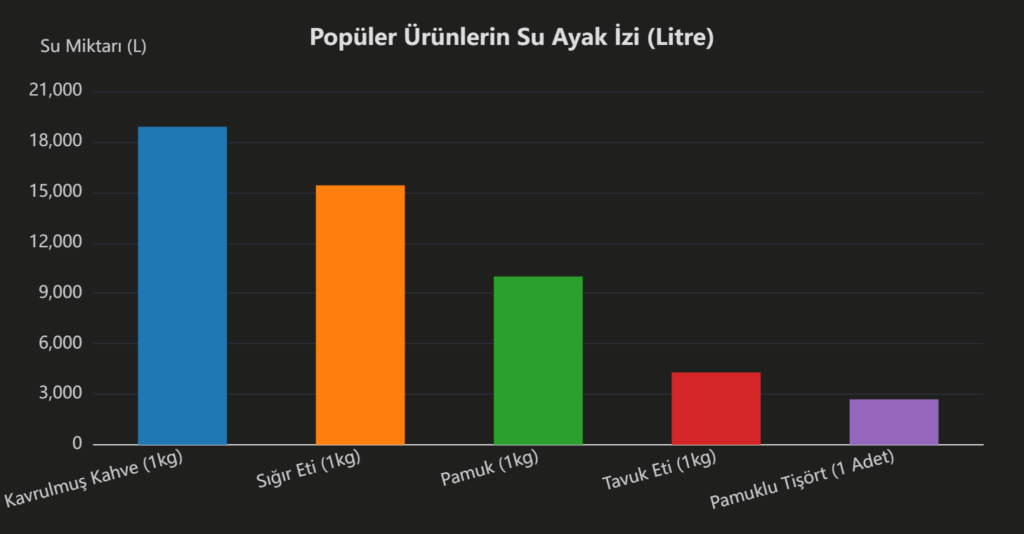
Water Footprint of Popular Products (Litres)
Just as with the figures above, the issue of food waste—a social scourge—is in fact a direct waste of fresh water, and once again indisputably demonstrates just how vitally important the ‘zero waste’ philosophy is in the modern world. For example, that single medium-sized apple you forgot in the corner of your fridge, left to rot and eventually thrown in the bin, actually means that an average of 125 litres of priceless rainwater (green water) – which nature generously expended to grow that fruit on the tree – is wasted forever. Throwing away the food we buy is equivalent to needlessly opening the floodgates of an invisible ecological dam, wasting fresh water and causing extremely destructive damage.
What are the key differences between a water footprint and a carbon footprint?
In discussions on environmental sustainability, ecosystem conservation and climate policy, there are two distinct terms that are frequently confused or mistakenly lumped together by the public and even, at times, by organisations: the water footprint and the carbon footprint. The carbon footprint and the carbon cycle, which are key drivers of the climate crisis, focus primarily on greenhouse gases such as carbon dioxide and methane released into the atmosphere, directly addressing macro-scale issues such as global warming and climate change. From the perspective of global warming potential, there is technically no significant difference or regional restriction as to where in the world carbon emissions or greenhouse gas emissions occur; carbon gases released into the atmosphere without limit in any industrialised part of the world ultimately have an equally adverse effect on the atmospheric composition and average temperature of the entire planet.
However, by its very nature and structure, the water footprint is an entirely regional, local metric that is closely tied to geography; this is because the freshwater resources essential to humanity are not distributed fairly, equally or homogeneously across the globe. For example, whilst establishing a water-intensive production facility in a northern, forested region that is extremely rich in water resources and receives abundant rainfall is a situation that nature can tolerate to a certain extent; establishing and operating exactly the same facility in a semi-arid region suffering from drought, with weak rainfall patterns and an already high level of water stress, could turn into an irreversible, devastating catastrophe for that region’s local ecosystem and agricultural future. For this very reason, when assessing water footprint inventories and reports, extremely precise calculations must always be carried out, taking into account the geographical location of production, the carrying capacity of local water resources and the water depletion rates specific to that particular catchment area.
Why Is the Water Footprint Growing? Agriculture, Industry and Fast Fashion
Due to population growth and rampant consumerism, humanity’s voracious demand for fresh water is increasing exponentially every year, reaching colossal proportions. The single greatest and most dangerous factor underlying this alarming situation is the current structure of modern industrial food systems, which is based on excessive consumption. Upon careful examination of the official data on this subject, it becomes a striking and undeniable fact that an incredible proportion – approximately 92 per cent – of humanity’s global water footprint and the world’s freshwater consumption stems solely from agricultural production and vast food systems. This scientific evidence clearly demonstrates that the primary and greatest source of the water scarcity problem lies directly with the food industry, and in particular with the industrial livestock sector, which relies on excessive water exploitation.
The ecological cost that red meat production imposes on the environment has long since reached alarming proportions, sounding a red alert in terms of sustainability. Comprehensive research has established that, on average, producing just 1 kilogram of beef requires the animal to consume thousands of kilograms of fodder; from the irrigation of these crops right through to the slaughterhouse stage, approximately 15,415 litresof fresh water are consumed from field to table. Such a colossal figure for water consumption lays bare, in all its stark mathematical reality, the immense and ruthless devastation that animal-protein-heavy diets—maintained solely for the sake of culinary pleasure—inflict upon local and global freshwater basins.
On the other hand, we must never forget or overlook the fact that agricultural water consumption involves the use of appalling amounts of water—not only for food production, but also for the production of vast quantities of raw materials for the textile industry. For example, the global production of cotton – one of the most fundamental textile raw materials – consumes approximately 222 billion cubic metres of fresh water worldwide every year; and as a bitter consequence of today’s frenzied ‘fast fashion’ trends, the production process for just one standard cotton T-shirtthat we add to our wardrobes draws exactly 2,700 litres of clean water from nature. Rapid textile consumption, driven by the constant purchase of garments that are worn only a few times before being discarded, and insatiable wardrobes are amongst the most ruthless key factors relentlessly fuelling global water stress.
How is a Water Footprint Calculated? Private Vehicles and the Corporate ISO 14046 Standard
In order to accurately determine the heavy ecological toll that our modern-day lifestyles and consumerism are taking on nature, and to face up to the reality that we cannot manage what we cannot measure; both practical calculators that individual users can easily apply in their own homes and stringent certification standards—which are binding for large corporate structures—have been developed in detail. Interactive online surveys and calculation tools available to individuals via the internet estimate your personal water footprint with a high degree of accuracy by asking questions across an extremely broad and specific range of topics – from the length of your daily shower to the frequency of your red meat consumption, from your car-washing habits to the frequency of your clothing purchases, enabling them to estimate your personal water footprint with a high degree of accuracy. It is particularly thought-provoking, even worrying, to examine the current situation in Turkey at this critical juncture; According to data compiled by the World Wildlife Fund (WWF) on our country, the average annual water footprint per person in Turkey is 1,977 cubic metres, and unfortunately this staggering figure is far, far above the global average of 1,243 cubic metres. This scientific statistic starkly illustrates, in the harshest terms, just how closely and urgently our country – despite being surrounded by seas – is facing the risk of geographical water stress.
Beyond individual use, on the corporate and commercial side of the matter, the calculation process takes on the form of an international framework that is far more rigorous, analytical, comprehensive, engineering-intensive and subject to independent audit. Professional facility managers, factory engineers and visionary sustainability directors meticulously apply the requirements and strict guidelines of the ISO 14046 Environmental Management Standardin order to report on the immense environmental impacts of the companies they manage on the international stage and to safeguard brand reputation. To provide a genuine and inspiring Turkish case study demonstrating the successful implementation of this standard: Özyeğin University has set an important precedent within the Turkish academic community by transparently publishing, every year, a water footprint inventory report that is 100 per cent compliant with ISO 14046 standards for its activities within its vast campus boundaries – a flawless example of corporate responsibility. For organisations, factories and brands, strict adherence to this global standard is not merely a marketing tool; it is the most critical and legally required step that must be taken to ensure genuine water efficiency within the global supply chain, to protect the ecosystem and to leave a liveable environment for future generations.
Highly Effective Strategies for Reducing Your Water Footprint
When it comes to protecting clean water sources, preventing drought and saving the ecosystem, the first things that spring to mind for many people are merely superficial solutions such as ‘turning off the tap whilst brushing your teeth’ or ‘taking a shorter shower’ – measures that are extremely traditional, well-intentioned but have only a minor impact. These direct water-saving methods at the tap are, of course, invaluable in terms of public awareness and must certainly be continued; however, the truly significant, transformative and massive change that will save the planet can only be achieved through resolute action plans that directly target our indirect (virtual) water consumption—as discussed throughout this article—by addressing the root of the problem and focusing on the bigger picture. It is a matter of vital importance that we implement, without delay and starting today, certain fundamental strategies—highly effective, integrable into daily life, extremely realistic and sustainable—to alleviate this significant burden of virtual water on our shoulders.
Changes in Diet and Consumption Habits
The only way to reduce our personal water footprint on an individual basis—in the quickest, most radical and most cost-effective way—is to ruthlessly review the daily consumption choices we make regarding the contents of our fridge in the kitchen and our wardrobe in the bedroom. By deliberately reducing the consumption of red meat products such as beef and lamb – which contain unimaginably high levels of virtual water – in our weekly diet; and opting instead for plant-based alternatives such as chicken, lentils and chickpeas – which are high in protein but require far less freshwater – yields an immense, incalculable ecological benefit for the natural world. In addition to our diet, rather than falling into the constantly renewing shopping trap set by the rapidly changing shop windows and the ‘fast fashion’ giants; as a conscious consumer, opting to buy second-hand clothing, opting for innovative recycled fabrics, and extending the lifespan of high-quality textiles you already own through careful maintenance—all of which instantly and directly curb fashion-related virtual water waste—constitutes an extremely powerful environmental stance.
Efficiency in Domestic and Office Use: Water Purifiers and Water Dispensers
Plastic-bottled water and massive water containers, which are presented as an indispensable part of our daily lives, are not only significant for the amount of water they contain; but also because of the immense amounts of virtual and grey water ruthlessly consumed from nature during the production of those thick, entirely petroleum-based plastic containers, their processing in factories, and their transport across continents or between cities via diesel-powered vehicles – all of which place a horrific, irreversible burden on our planet. To completely and fundamentally eliminate the plastic-induced water footprint of bottled water lining supermarket shelves from our lives, we must begin using high-quality water purification systemswith advanced filtration technology in our living spaces and kitchen; whilst consigning single-use plastic waste—which takes centuries to break down in nature—to the dustbin of history, whilst also providing the convenience of 24/7 access to uninterrupted, mineral-balanced and healthy fresh water for our families. These domestic technological solutions represent the most fundamental and tangible step an individual can take towards environmental awareness and sustainable, independent water management.
However, when we move beyond our private living spaces into the world of work – into corporate offices and the bustling environments of office complexes where thousands of people work – the scale of the issue becomes even greater. Constantly ordering plastic water bottles for departments to meet staff’s daily healthy water needs—a process spanning from production to transport, and from the disinfection of the plastic to its storage—imposes a massive, unmanageable carbon and water footprint on the company. Instead, using Rainwater office water dispensers—which utilise advanced reverse osmosis or ultrafiltration technologies and integrate hygienically and directly with the mains water supply, operating with zero contact— eliminates in one fell swoop the fuel emissions from logistics operations involving constant deliveries of water bottles, the tonnes of unnecessary plastic waste, and the toxic greywater generated during the washing of this plastic, thereby making a visionary and direct contribution to companies’ corporate sustainability (ESG) objectives. Plastic-free, on-site water consumption solutions that eliminate external dependency lie at the very heart of modern corporate environmentalism in the 21st century.
Corporate Water Management: Zero Wastewater and Rainwater Harvesting
For brands, factories in organised industrial zones, large-scale production facilities and major commercial complexes in metropolitan areas, on-site corporate water management planning is not merely a cost-saving measure; it serves as the most crucial lifeline in a visionary ecological strategy to counter the risk of future droughts. Thanks in particular to ‘zero liquid discharge’ (ZLD) engineering projects, which are rapidly gaining ground in industry, tonnes of fresh water used for cooling or washing in massive industrial processes, is reused repeatedly within a closed loop via advanced biological and chemical treatment units installed on-site, rather than being discharged externally; this almost completely minimises the amount of that precious blue water drawn from rivers or groundwater basins in the natural environment. Under the same roof, thanks to modern rainwater harvesting systems installed on the vast roof surfaces of massive buildings, thousands of tonnes of valuable ‘green water’ – collected and filtered in winter and spring – are used as a free and environmentally friendly alternative in numerous vital areas, ranging from the irrigation of the facilities’ landscaping, to toilet cisterns, from vehicle wash stations to industrial cooling towers, thereby significantly reducing the strain on the region’s local fresh water reserves and reservoirs to a very substantial degree—a reduction that can be proven by the figures.
Frequently Asked Questions
What is the concept of a water footprint?
The concept of a water footprint does not refer solely to the direct water that an ordinary citizen physically observes and consumes from the tap at home—whether whilst washing their hands, taking a shower or watering flowers. This term is a highly comprehensive and detailed ecological measurement and tracking unit that encompasses, behind the scenes and in ways we cannot see. In short, it is a mathematical and realistic summary of the total volume of fresh water that we irreversibly demand and extract from nature in order to sustain our current modern living standards and comfort around the world without disruption.
What causes a water footprint?
The most fundamental, significant and destructive cause of the water footprint is agricultural irrigation, which accounts for an astonishingly overwhelming 92 per cent of global water consumption statistics, alongside wasteful irrigation methods and the insatiable drive for animal-based food production. The intensive cultivation of billions of acres of land, coupled with the ceaseless demand for clean water and fodder crops from billions of livestock raised to produce the meat that ends up on our tables, are the main pillars creating this colossal footprint on a global scale. Furthermore, the ruthless ‘fast fashion’ trends on industrial production lines, the textile and leather industries, the vast quantities of dilution water (greywater); and modern humanity’s ever-increasing, insatiable and mindless domestic consumption habits; these are among the primary factors creating this heavy, unbearable burden on the world’s already limited freshwater resources.
What is a water footprint, and how can it be reduced?
Put simply, your water footprint is the total cost to the environment of all the direct and indirect fresh water consumption you cause throughout your life. The most significant step you can take to reduce this hefty bill—that is, your water footprint—to reasonable levels is, first and foremost, optimising red meat consumption in the kitchen and adopting a more plant-based, balanced and healthy diet, whilst absolutely preventing the wastage of food—which has travelled with great difficulty from the field to the supermarket shelf and then to our tables—from going off and ending up in the bin. Furthermore, rather than buying brand-new clothes, T-shirts and trousers every new season or during every sales campaign, ‘slowing down fashion’ – by opting for high-quality, second-hand or innovatively recycled garments – yields an incredibly significant saving in virtual water. Furthermore, rather than constantly buying and consuming water from plastic bottles or high-emission plastic jugs; in our homes and in the busy offices where we work, using high-quality water purification systems featuring advanced filtration technology to completely eliminate virtual water consumption stemming from the oil and packaging industries in one fell swoop; this is one of the most effective, sensible and sustainable actions we can take for nature and for our future.
What are some examples of a water footprint?
To visualise and better understand invisible water consumption—that is, virtual water—more clearly, the seriousness of the situation becomes clearer when we look at the most striking examples from our daily lives; for example, when you factor in all the feed, clover and water consumed by the animal over many months to produce just 1 kilogram of beef that you buy from the supermarket, an average of 15,415 litres of freshwater is used – a staggering amount. In the textile and clothing sector, the production of just a single standard cotton T-shirt – the one we see and like in a shop window at a shopping centre – involves the extraction of approximately 2,700 litres of priceless water from nature throughout the entire process, from the moment the seed is sown in the field, to the fabric being woven, dyed and delivered to the shop counter, approximately 2,700 litres of priceless water are drawn from nature. In fact, even the seemingly innocent single small cup of coffee that we love to sip every morning to wake up and start the day with energy has an ecological and indirect cost—from the fields on the other side of the world to our table—equivalent to an average of 140 litres of fresh water, laying bare the invisible danger of virtual water in all its stark reality.
Remember, in the face of the global climate crisis—whose effects are being felt more acutely with each passing day—and the looming risk of severe drought and freshwater scarcity, every conscious step we take as individuals, however small it may seem; actually has the potential to create an unimaginably large butterfly effect in terms of alleviating our immense, yet invisible, ecological burden. By reshaping our daily consumption habits – such as food, clothing and energy – with eco-friendly, conscious choices, and by integrating the modern water purification innovations offered by scientific technology into our lives, our offices and homes without delay, we can both secure healthy water for ourselves and build a greener, water-rich, bluer world for future generations. Share the unique insights in this thoroughly researched guide right now on your social media accounts, with your friends and colleagues; take action today, right now, without waiting for tomorrow, to create that much-needed widespread awareness in the name of corporate sustainability and the salvation of our planet!
 Copy Blog Link