TR
TR
 21 September 2026
Nowadays, when access to clean water has become a global necessity, the question of what ultrafiltration is—a process encountered across a wide range of applications, from industrial facilities to domestic use—forms the basis of modern water treatment technologies. Commonly known as UF, this technology carries out a physical filtration process by passing water through a semi-permeable membrane with microscopic pores, utilising hydrostatic pressure. The system’s greatest advantage is that it operates by creating a purely physical barrier, without adding any synthetic chemicals or chlorine to the water. With pore sizes ranging from 0.01 to 0.1 microns, these systems prevent the passage of suspended solids such as clay, sand and silt, as well as pathogens. According to current data setting health and hygiene standards, UF technology has the capacity to remove 99.99 per cent of bacteria and viruses from water entirely through physical means (Expert Market Research). This remarkable separation capability makes ultrafiltration an indispensable solution in both B2B industrial water management and B2C domestic purified water consumption.
The Basic Operating Principle and Mechanism of Ultrafiltration Systems
The ultrafiltration system operates on a mechanism that is, in principle, quite simple but extremely precise at the microscopic level. The raw water to be treated is pumped from the system’s inlet into the membrane module at a specific hydrostatic pressure. This pressure difference (transmembrane pressure) creates a driving force that allows water molecules and beneficial trace minerals—such as calcium and magnesium, which are essential for human health—to pass through the membrane. The clean liquid that successfully passes through the membrane and is purified is called ‘permeate’. On the other hand, organic matter, macromolecules, colloids, viruses and bacteria – which are much larger than the membrane pores – are trapped on the surface of the membrane and remain behind; this concentrated waste liquid is called ‘retentate’. This process is an entirely physical separation process and enables the production of pure water without altering the natural composition or pH balanceof the water.
Dead-End and Cross-Flow Filtration Systems
The system’s efficiency is designed in two different configurations, depending on the angle and manner in which the contaminated water is fed to the membrane. In the dead-end filtration method, the water is fed directly onto the membrane at a right angle. All incoming water is forced to pass through the membrane, and the separated contaminants accumulate directly on the membrane surface, forming a cake layer. Whilst this method offers energy savings in low-concentration waters, it requires frequent backwashing as the surface becomes clogged quickly.
In contrast, in cross-flow filtration systems, water is pumped in a continuous flow parallel to the membrane surface. As the water passes through the membrane, the sweeping effect created by the parallel flow largely prevents contaminants from adhering to and accumulating on the membrane surface. Cross-flow configurations, which are particularly favoured for the treatment of industrial waters with high turbidity, significantly extend the system’s fouling interval, thereby maximising operational efficiency.
UF Membrane Technologies, Materials and Module Types
The membranes at the heart of ultrafiltration systems are manufactured from different materials depending on the application, the chemical characteristics of the water and its temperature. Polymeric membranes are the most commonly used material in accordance with current industry standards. Manufactured from advanced polymers such as polyethersulphone (PES), polyvinylidene fluoride (PVDF) and polyacrylonitrile (PAN), these membranes stand out for their flexibility and cost-effectiveness. According to global market analyses, polymeric membranes are the undisputed leaders in the sector, holding a 64.8 per cent market share (Grand View Research). However, ceramic membranes – which have emerged as a rising trend in recent years – are establishing a firm foothold, particularly in heavy industry, thanks to their high chemical resistance, resistance to extreme temperatures and long service life.
Tubular and Hollow Fibre System Preferences
In order for membranes to be used in industrial and commercial applications, they must be housed within a specific casing to form a module. The two most common housing designs on the market are tubular systems and hollow-fibre systems. Tubular systems feature wide channels designed in the shape of tubes and deliver high performance without the risk of blockage, particularly when treating viscous water or waste water containing high levels of suspended solids.
Hollow-fibre systems, on the other hand, consist of thousands of spaghetti-like, thin fibre tubes placed inside a tube. Either the inside or the outside of these micro-tubes acts as the filtration surface. The greatest advantage of this design is that it provides an enormous surface area within a very small volume, thereby increasing filtration capacity to an extraordinary degree.
As can be seen from the graph, the choice of industrial modules is determined by the level of difficulty of the applications:
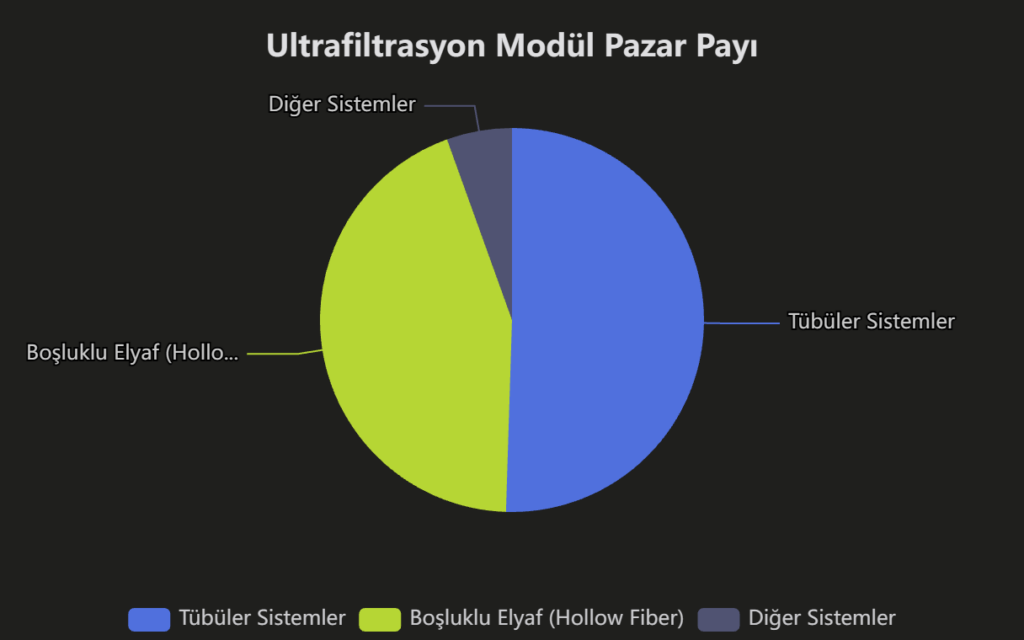
The data visualisation above reflects the sector-specific module usage rates derived from market research.
Applications of Ultrafiltration in the Industrial and Domestic Sectors
With advances in technology, the scope of ultrafiltration has not been limited to water treatment plants alone, but has expanded to cover a wide range of sectors, from food to medicine. However, water and wastewater management continues to represent the system’s most critical area of application, due to the pressure of drought caused by global warming.
Drinking Water Treatment and the Reliability of UF in Domestic Water Dispensers
Individual consumers and office managers are seeking advanced solutions to eliminate the smell of chlorine, heavy metals and potential microbiological contamination from tap water. UF technology is an excellent alternative for domestic use as it completely removes harmful pathogens whilst preserving the water’s natural mineral composition (calcium and magnesium). In particular, stylish and modern home and office water dispensers, designed in accordance with international NSF (National Sanitation Foundation) standards, put an end to the use of plastic bottles, offering healthy, sustainable and uninterrupted drinking water.
Pre-treatment Shield for Wastewater Recovery and RO (Reverse Osmosis)
UF systems play a key role in the processes of treating industrial wastewater or recycling it back into the plant before it is discharged into the environment. According to research, water and wastewater treatment projects account for a substantial 58 per cent of global ultrafiltration applications (Fact.MR). Furthermore, it is used as a strategic ‘pre-filter’ (barrier) prior to Reverse Osmosis (RO) systems, which are far more sensitive and expensive. The UF membrane removes clay, sediment and bacteria from the water before it reaches the RO membrane, thereby preventing fouling and physical damage to the RO membranes, thus dramatically extending the plant’s overall service life.
The Effect of ‘Cold Pasteurisation’ in the Medical (Haemodialysis) and Food Industries
In the healthcare sector, ultrafiltration (UF) is a vital medical procedure in haemodialysis treatments for patients who have lost kidney function. Using this method, known as ‘isolated ultrafiltration’, excess fluid that has accumulated in the patient’s blood – and which poses risks such as decompensated heart failure or hypervolemia – is safely removed from the body. In the food and beverage industry, it is used in the processing of milk, whey and fruit juices. This process, which removes bacteria without the application of high heat, is known in the industry as ‘cold pasteurisation’. It extends the shelf life of foods that have not undergone heat treatment without compromising their taste, aroma or nutritional value.
The Key Advantages of Ultrafiltration Over Traditional Methods
Compared to traditional sand filters or chemical coagulation tanks, the ultrafiltration system offers very clear purchasing metrics. Firstly, the operating pressure required by the system is quite low (typically between 1 and 3 bar). This eliminates the need for massive industrial pumps, minimising the plant’s energy consumption and ensuring compliance with green energy targets.
Furthermore, the system has an extremely compact footprint. Compared to large reinforced concrete sedimentation tanks, water treatment on a massive scale can be carried out in a small area, even within modular containers. High chlorine resistance, flexible capacity expansion and the absence of chemical use significantly reduce operational costs (OPEX) for B2B decision-makers seeking modern water treatment systems.
Operational Challenges: Membrane Fouling and CIP Cleaning Procedures
Although they are high-performance, the greatest engineering problem faced by UF membranes over time is membrane fouling. Filtered organic matter, inorganic salts and biological films block the pores, causing a drop in water permeability (flux). To overcome this operational challenge, the systems are equipped with automatic ‘backwash’ algorithms; clean water is forced through in the opposite direction at regular intervals to dislodge and remove the cake layer from the pores.
However, in cases of stubborn biological or chemical contamination where backflushing proves insufficient, the CIP (Cleaning In Place) procedure is employed. The CIP unit restores the system to its original performance by washing the membranes with special acidic or alkaline solutions without removing them from the system. A properly planned CIP procedure can extend the service life of the membranes to between 5 and 7 years.
A Comparison of Microfiltration, Ultrafiltration, Nanofiltration and Reverse Osmosis (RO)
Decision-makers need to have a good understanding of filtration precision when selecting the right treatment technology for their projects. The table below compares the four key membrane technologies used in the water treatment sector:
| Filtration Technology | Pore Size (microns) | Operating Pressure | Pollutants It Removes |
| Microfiltration (MF) | 0.1 – 10 | Low (1–3 bar) | Large particles, sand, sediment, certain bacteria |
| Ultrafiltration (UF) | 0.01 – 0.1 | Low/Medium (1–5 bar) | Viruses, all bacteria, colloids, macromolecules |
| Nanofiltration (NF) | 0.001 – 0.01 | Medium/High (5–15 bar) | Bivalent ions (hardness/lime), pesticides |
| Reverse Osmosis (RO) | < 0.001 | High (15–80 bar) | All dissolved salts, metal ions, complete demineralisation |
These different technologies are not in competition with one another; rather, they are complementary modular components within integrated treatment plants. Hybrid configurations (e.g. UF + RO) are frequently chosen to meet specific requirements.
Recent Developments in the Sector and Hybrid System Technologies
Ultrafiltration technology is undergoing a major evolution through the integration of Industry 4.0 components. In the new generation of UF plants being commissioned today, AI-powered smart sensors are now being utilised. These sensors analyse the fouling load on the membrane within milliseconds, thereby autonomously optimising backwash and CIP cycles; this prevents unnecessary wastage of water and energy. Furthermore, in line with targets to achieve a zero carbon footprint, sustainable and autonomous ultrafiltration modules – which derive their energy entirely from integrated solar panels – are creating revolutionary solutions in remote locations, disaster-stricken areas or off-grid facilities.
Frequently Asked Questions
What is ultrafiltration used for?
Ultrafiltration (UF) plays a vital role in both industrial water treatment systems and the healthcare sector. In the field of water treatment, it produces pure and clear water by physically removing 99.9 per cent of viruses, bacteria, clay and organic matter from the water without adding any chemicals. In the healthcare sector (haemodialysis), it helps to safely filter and remove the life-threatening excess fluid that accumulates in the blood of patients with kidney failure. It is also widely used in the food industry for the processing of whey and the clarification of fruit juices.
What is the ultrafiltration technique?
The ultrafiltration technique operates on the principle of an advanced ‘sieve’ with pores of microscopic dimensions (0.01–0.1 microns). This technique relies on passing contaminated water or blood through a semi-permeable membrane using a low driving force (hydrostatic pressure). Under pressure, water molecules and beneficial small minerals pass easily through the pores in the membrane (permeate); whilst bacteria, viruses, sediments and large proteins – which are much larger than the pores in the membrane – become trapped by the membrane and are left behind (retentate). It is an entirely physical process of filtration and separation.
Contact us for customised UF water treatment solutions for your project
Whether you are planning a wastewater recovery project for a large-scale industrial facility or wish to optimise the quality of your office’s daily drinking water, selecting the ultrafiltration equipment best suited to your needs requires engineering expertise. To discover the optimal UF membrane systems, designed to suit your capacity requirements, the characteristics of the water being treated and your site constraints, please get in touch with our team of expert engineers. You can take your first step towards sustainable water management by filling in our free site survey and quotation request form.
 Copy Blog Link